Tuesday, July 01, 2008
Dimitris Lyacos
Z213 Exit (extracts 11-12)
Translated from Greek by Shorsha Sullivan
11
I think of you but not as I used to. My eyes open in
sleep, a hand seizes me. And in the sweetness of
somebody’s touch. I am falling, and the same dream
again of a child’s breast that a woman holds in her
arms. Lips on it, wet, blood-soaked her lips. I start
upright. The others are sleeping. Days walking uphill,
view of an evergreen plateau, stay there. Quiet.
Except when the wounded mumble close to your ear. I
took something that made me get over my fears and then
I didn’t care about anything. I did not care about
anything. I couldn’t care about anything, a knife cut
took off my finger, and I couldn’t care about stopping
the blood. Nothing to stay for. The daybreak of a Pel
re dawn without light. And around one side and
the other monasteries empty nests and a whole crowd
there, a river between. And there were a lot. They are
singing, the bridal chambers are filled, holding
hands. Below bodies the stream hustles along, on the
bank a row of them fallen face upwards, I run around
like a madman looking for you, a woman presses her
daughter to her, poor, we haven’t eaten for days.
Gleam without hope still gleaming. In the dreams
jostling the one in my other. As then a boy on top of
his mother, help me to lift her, he was holding her
tight by her soaked rags, have you got matches strike
one, as if in her hands. Shows me black avenues and a
door at the end. My name that I saw written on it.
First time I felt this kind of pain, like a bite. I
saw, yet another soldier fallen nearby. Tears in his
eyes, called out where are you. Could not see, black
with the soil, don’t drink from this water, couldn’t
hear, the march past blanked it out. And it was the
memorial chanted for us. On our backs, above us the
poplars all round. For what was lost, country and
youth we had lost. For the horses rolling in blood.
And then their carcasses rest under the olive trees.
When the sacrifice starts and they pour something over
us. Where are you. And they are all gone there are
only the gods that off their jackets and give us
cover. Dead holding on to images scattered until they
too fade forever away. And I see the others, do not go
near leave them get up by themselves. Like the bare
ramrod hitting you in the stomach, a saw, an empty
water-bottle. I recall. New Year’s Eve. And deep down
a knot. Sleeping beside me, who. As if to my words he
whispers an answer. Now it grows dark, I am a child, I
encounter the gypsy. Who takes by day to the roads and
sings. In distant villages, in the graveyards for
charity. They said he was dead. And during Carnival,
in the squares roaming about. Comes and asks us to
light a cigarette for him. Deep down a knot, memory,
poor girl. Working all night, ruffling through
uniforms. In the cloakroom of travelling players,
should you find something to change. Your face fading
again, to hold your head for a while, and your body is
warm and when you are bending to kiss me you hesitate
for a moment, as if you catch the sound of them
coming. Or the sound of water or wooden fingers on
drums. Beside me late flowers on your mouth and it is
your kiss. The eve of the lights do you remember? On
the day itself I dig into the stone wall and bury
there the crown of a fir tree. Scapegoat, then, then
we were together.
12
Cruel the evening again in the station the train and
another station silent and the train tail of an animal
somewhere ahead, and another station alien eyes not on
you yet you want to hide again, a long narrow passage
that flows away in the rain covers you. Sitting still
you can’t manage your thoughts cannot make you stand
up you cannot go forwards or backwards. Socks wet,
take off your shoes, not yet, you stay still, almost
as to abandon the world, the lights go by, nothing but
lights, nothing exists besides this. No thought moves
your body not even a pain. One by one all those that
fled all those you left, pieces, pieces like ice
breaking and falling in front of your feet. And it
melts before you can move. The rhythm of the metal
draws you with it a shadow out in the corridor
lighting a cigarette the same tree that had passed
before you so many times. You smoke too. You take off
shoes socks lie down. Cramp in the stomach, the usual.
You cover your feet with the pullover, fall face down.
Chilly berth that sticks on your face. You wear the
pullover, you put the Bible under the jacket for a
pillow. Her breast, her half-opened mouth. Some life.
You unbutton your trousers put your hand in. A hand
that holds you a body you stretched on top of. She is
there you almost touch her and she is gone again,
saliva, pale light and the listless pulse of the body
powerless almost. You hold your breath, her breasts
come, you press it hard, comes inside you, from inside
you squeeze as many drops as you can, from inside you.
Stay still, calm, empty, darkness hides you, then
sleep. A nudge, you slip all but fall, you put out
your hand, below the palm crumpled paper, a dog-eared
book open. Turn over the cover: The First Death. You
would smile. This too for a pillow, on top of the
Bible. When you wake again two bodies entwined, the
flesh between them in pieces, that melt, breast onto
breast, that fades one into the other, fading out when
you decide to stand up.
Dimitris Lyacos was born in Athens in 1966. His trilogy Poena Damni (Z213: Exit, Nyctivoe, The First Death) has been translated into English, Spanish, Italian and German and has been performed extensively across Europe and the USA. A sound and sculpture installation of Nyctivoe opened in London and toured Europe in 2004-2005. A contemporary dance version of the same book was showing in Greece between 2006-2007 culminating in a performance at the Athens Concert Hall (Megaro Mousikis). Lyacos' work has been the subject of lectures and research at various universities, including Amsterdam, Trieste and Oxford. The German translation of The First Death is due to appear by J.Frank Verlag in the forthcoming months. For more information on the author visit www.lyacos.net.
Shorsha Sullivan was born in Dublin in 1932. He studied Classics at Leeds and has spent most of his working life in England. He has an interest in Modern Greek theatre and poetry.
Dimitris Lyacos Steve Dalachinsky Carrie Hunter Lauren Joslin Charles Frederickson
Translated from Greek by Shorsha Sullivan
11
I think of you but not as I used to. My eyes open in
sleep, a hand seizes me. And in the sweetness of
somebody’s touch. I am falling, and the same dream
again of a child’s breast that a woman holds in her
arms. Lips on it, wet, blood-soaked her lips. I start
upright. The others are sleeping. Days walking uphill,
view of an evergreen plateau, stay there. Quiet.
Except when the wounded mumble close to your ear. I
took something that made me get over my fears and then
I didn’t care about anything. I did not care about
anything. I couldn’t care about anything, a knife cut
took off my finger, and I couldn’t care about stopping
the blood. Nothing to stay for. The daybreak of a Pel
re dawn without light. And around one side and
the other monasteries empty nests and a whole crowd
there, a river between. And there were a lot. They are
singing, the bridal chambers are filled, holding
hands. Below bodies the stream hustles along, on the
bank a row of them fallen face upwards, I run around
like a madman looking for you, a woman presses her
daughter to her, poor, we haven’t eaten for days.
Gleam without hope still gleaming. In the dreams
jostling the one in my other. As then a boy on top of
his mother, help me to lift her, he was holding her
tight by her soaked rags, have you got matches strike
one, as if in her hands. Shows me black avenues and a
door at the end. My name that I saw written on it.
First time I felt this kind of pain, like a bite. I
saw, yet another soldier fallen nearby. Tears in his
eyes, called out where are you. Could not see, black
with the soil, don’t drink from this water, couldn’t
hear, the march past blanked it out. And it was the
memorial chanted for us. On our backs, above us the
poplars all round. For what was lost, country and
youth we had lost. For the horses rolling in blood.
And then their carcasses rest under the olive trees.
When the sacrifice starts and they pour something over
us. Where are you. And they are all gone there are
only the gods that off their jackets and give us
cover. Dead holding on to images scattered until they
too fade forever away. And I see the others, do not go
near leave them get up by themselves. Like the bare
ramrod hitting you in the stomach, a saw, an empty
water-bottle. I recall. New Year’s Eve. And deep down
a knot. Sleeping beside me, who. As if to my words he
whispers an answer. Now it grows dark, I am a child, I
encounter the gypsy. Who takes by day to the roads and
sings. In distant villages, in the graveyards for
charity. They said he was dead. And during Carnival,
in the squares roaming about. Comes and asks us to
light a cigarette for him. Deep down a knot, memory,
poor girl. Working all night, ruffling through
uniforms. In the cloakroom of travelling players,
should you find something to change. Your face fading
again, to hold your head for a while, and your body is
warm and when you are bending to kiss me you hesitate
for a moment, as if you catch the sound of them
coming. Or the sound of water or wooden fingers on
drums. Beside me late flowers on your mouth and it is
your kiss. The eve of the lights do you remember? On
the day itself I dig into the stone wall and bury
there the crown of a fir tree. Scapegoat, then, then
we were together.
12
Cruel the evening again in the station the train and
another station silent and the train tail of an animal
somewhere ahead, and another station alien eyes not on
you yet you want to hide again, a long narrow passage
that flows away in the rain covers you. Sitting still
you can’t manage your thoughts cannot make you stand
up you cannot go forwards or backwards. Socks wet,
take off your shoes, not yet, you stay still, almost
as to abandon the world, the lights go by, nothing but
lights, nothing exists besides this. No thought moves
your body not even a pain. One by one all those that
fled all those you left, pieces, pieces like ice
breaking and falling in front of your feet. And it
melts before you can move. The rhythm of the metal
draws you with it a shadow out in the corridor
lighting a cigarette the same tree that had passed
before you so many times. You smoke too. You take off
shoes socks lie down. Cramp in the stomach, the usual.
You cover your feet with the pullover, fall face down.
Chilly berth that sticks on your face. You wear the
pullover, you put the Bible under the jacket for a
pillow. Her breast, her half-opened mouth. Some life.
You unbutton your trousers put your hand in. A hand
that holds you a body you stretched on top of. She is
there you almost touch her and she is gone again,
saliva, pale light and the listless pulse of the body
powerless almost. You hold your breath, her breasts
come, you press it hard, comes inside you, from inside
you squeeze as many drops as you can, from inside you.
Stay still, calm, empty, darkness hides you, then
sleep. A nudge, you slip all but fall, you put out
your hand, below the palm crumpled paper, a dog-eared
book open. Turn over the cover: The First Death. You
would smile. This too for a pillow, on top of the
Bible. When you wake again two bodies entwined, the
flesh between them in pieces, that melt, breast onto
breast, that fades one into the other, fading out when
you decide to stand up.
Dimitris Lyacos was born in Athens in 1966. His trilogy Poena Damni (Z213: Exit, Nyctivoe, The First Death) has been translated into English, Spanish, Italian and German and has been performed extensively across Europe and the USA. A sound and sculpture installation of Nyctivoe opened in London and toured Europe in 2004-2005. A contemporary dance version of the same book was showing in Greece between 2006-2007 culminating in a performance at the Athens Concert Hall (Megaro Mousikis). Lyacos' work has been the subject of lectures and research at various universities, including Amsterdam, Trieste and Oxford. The German translation of The First Death is due to appear by J.Frank Verlag in the forthcoming months. For more information on the author visit www.lyacos.net.
Shorsha Sullivan was born in Dublin in 1932. He studied Classics at Leeds and has spent most of his working life in England. He has an interest in Modern Greek theatre and poetry.
Dimitris Lyacos Steve Dalachinsky Carrie Hunter Lauren Joslin Charles Frederickson
Steve Dalachinsky
another cloud poem (sunset)
i bruise easily
these days come hither
to the underbellies of (the) clouds
this sunset too true to be
good
the bruised to a cinder
clouds
the gulls have found something
to squabble about
& fill their bellies with
down there just below the water's
ripplin surface
little mountains of eruption
moving against eachother where i banged
my knee (almost) & it burnt
like the orgasm i had this morning
that spewed forth nothing but
smarted more than this bulbous sun
as i walked into it &
burnt like the underbellies of these clouds
2 ticks of a rereflection
or myriads of 'em
bonifide doowop (g)list'nings
& short of what double means
& the new trees planted around my feet
i kissed 'em all the other day
& bade them grow
in good spirit
then walked to the river
tied a rope around my bruises
& threw 'em in
the gulls went diving & squawking
all the way under
then spit when they discovered there
was nothing there to
nourish them
& as it turned dark
the bellies of the clouds turned
grey again
& i rose up &
blinked.
coda:
the lights of the other city
came on unnoticed
& my footsteps became
water.
steve dalachinsky nyc 4/14/08
steve dalachinsky was born in 1946, Brooklyn, New York. His work has appeared extensively in journals on & off line including; Big Bridge, Milk, Unlikely Stories, Xpressed, Ratapallax, Evergreen Review, Long Shot, Alpha Beat Soup, Xtant, Blue Beat Jacket, N.Y. Arts Magazine, 88 and Lost and Found Times. He is included in such anthologies as Beat Indeed, The Haiku Moment and the esteemed Outlaw Bible of American Poetry. He has written liner notes for the CDs of many artists including Anthony Braxton, Charles Gayle, James "Blood" Ulmer, Rashied Ali, Roy Campbell, Matthew Shipp and Roscoe Mitchell. His 1999 CD, Incomplete Direction (Knitting Factory Records), a collection of his poetry read in collaboration with various musicians, such as William Parker, Matthew Shipp, Daniel Carter, Sabir Mateen, Thurston Moore (SonicYouth), Vernon Reid (Living Colour) has garnered much praise. His most recent chapbooks include Musicology (Editions Pioche, Paris 2005), Trial and Error in Paris (Loudmouth Collective 2003), Lautreamont's Laments (Furniture Press 2005), In Glorious Black and White (Ugly Duckling Presse 2005), St. Lucie (King of Mice Press 2005), Are We Not MEN & Fake Book (2 books of collage - 8 Page Press 2005), Dream Book (Avantcular Press 2005). His books include A Superintendent's Eyes (Hozomeen Press 2000) and his PEN Award winning book The Final Nite (complete notes from a Charles Gayle Notebook, Ugly Duckling Presse 2006). His latest CD is Phenomena of Interference, a collaboration with pianist Matthew Shipp (Hopscotch Records 2005). He has read throughout the N.Y. area, the U.S., Japan and Europe, including France and Germany.
Dimitris Lyacos Steve Dalachinsky Carrie Hunter Lauren Joslin Charles Frederickson
i bruise easily
these days come hither
to the underbellies of (the) clouds
this sunset too true to be
good
the bruised to a cinder
clouds
the gulls have found something
to squabble about
& fill their bellies with
down there just below the water's
ripplin surface
little mountains of eruption
moving against eachother where i banged
my knee (almost) & it burnt
like the orgasm i had this morning
that spewed forth nothing but
smarted more than this bulbous sun
as i walked into it &
burnt like the underbellies of these clouds
2 ticks of a rereflection
or myriads of 'em
bonifide doowop (g)list'nings
& short of what double means
& the new trees planted around my feet
i kissed 'em all the other day
& bade them grow
in good spirit
then walked to the river
tied a rope around my bruises
& threw 'em in
the gulls went diving & squawking
all the way under
then spit when they discovered there
was nothing there to
nourish them
& as it turned dark
the bellies of the clouds turned
grey again
& i rose up &
blinked.
coda:
the lights of the other city
came on unnoticed
& my footsteps became
water.
steve dalachinsky nyc 4/14/08
steve dalachinsky was born in 1946, Brooklyn, New York. His work has appeared extensively in journals on & off line including; Big Bridge, Milk, Unlikely Stories, Xpressed, Ratapallax, Evergreen Review, Long Shot, Alpha Beat Soup, Xtant, Blue Beat Jacket, N.Y. Arts Magazine, 88 and Lost and Found Times. He is included in such anthologies as Beat Indeed, The Haiku Moment and the esteemed Outlaw Bible of American Poetry. He has written liner notes for the CDs of many artists including Anthony Braxton, Charles Gayle, James "Blood" Ulmer, Rashied Ali, Roy Campbell, Matthew Shipp and Roscoe Mitchell. His 1999 CD, Incomplete Direction (Knitting Factory Records), a collection of his poetry read in collaboration with various musicians, such as William Parker, Matthew Shipp, Daniel Carter, Sabir Mateen, Thurston Moore (SonicYouth), Vernon Reid (Living Colour) has garnered much praise. His most recent chapbooks include Musicology (Editions Pioche, Paris 2005), Trial and Error in Paris (Loudmouth Collective 2003), Lautreamont's Laments (Furniture Press 2005), In Glorious Black and White (Ugly Duckling Presse 2005), St. Lucie (King of Mice Press 2005), Are We Not MEN & Fake Book (2 books of collage - 8 Page Press 2005), Dream Book (Avantcular Press 2005). His books include A Superintendent's Eyes (Hozomeen Press 2000) and his PEN Award winning book The Final Nite (complete notes from a Charles Gayle Notebook, Ugly Duckling Presse 2006). His latest CD is Phenomena of Interference, a collaboration with pianist Matthew Shipp (Hopscotch Records 2005). He has read throughout the N.Y. area, the U.S., Japan and Europe, including France and Germany.
Dimitris Lyacos Steve Dalachinsky Carrie Hunter Lauren Joslin Charles Frederickson
Carrie Hunter
The Unicorns
47.
A unicorn for Iyanna,
with an 80's asymmetrical haircut.
If I had any power.
Luck twists itself out of me.
My insistence on.
Red buttons drop like seeds.
I may have entered.
Everything I see is.
49.
Orange cones in snow.
One or more bound variables.
Crystal seer.
"What you need to know."
"What you need to know."
Yell it louder.
50.
Every constellation is not made of stars.
Stairs that turn,
I want to be them.
What my mother would tell me
if she were here.
The windowsill hurts.
Every fear protecting you from what is feared.
Apple. Jacks.
51.
Putting things away.
A wish for stories
and stones to throw.
Glinted gift you carry back.
A smile in poverty,
but not amongst.
Having never learned to can.
What he said about what I could not understand.
There are no bumblebees here.
Yellow laughter could be what you wanted.
Carrie Hunter has been published online in Moria Poetry, Eratio Postmodern Poetry, Aught, Turntable & Blue Light, Dusie, Parcel, and Sawbuck, and in print in SCORE magazine, CRIT Journal 2, and Small Town XII. Her chapbook Vorticells was published by Cy Gist Press, and an e-chapbook Kine(sta)sis was published by Dusie, a portion of which is also featured in Jacket 35. She received her MFA/MA in Poetics at New College of California, edits ypolita press (ypolitapress.blogspot.com), and lives in San Francisco.
Dimitris Lyacos Steve Dalachinsky Carrie Hunter Lauren Joslin Charles Frederickson
47.
A unicorn for Iyanna,
with an 80's asymmetrical haircut.
If I had any power.
Luck twists itself out of me.
My insistence on.
Red buttons drop like seeds.
I may have entered.
Everything I see is.
49.
Orange cones in snow.
One or more bound variables.
Crystal seer.
"What you need to know."
"What you need to know."
Yell it louder.
50.
Every constellation is not made of stars.
Stairs that turn,
I want to be them.
What my mother would tell me
if she were here.
The windowsill hurts.
Every fear protecting you from what is feared.
Apple. Jacks.
51.
Putting things away.
A wish for stories
and stones to throw.
Glinted gift you carry back.
A smile in poverty,
but not amongst.
Having never learned to can.
What he said about what I could not understand.
There are no bumblebees here.
Yellow laughter could be what you wanted.
Carrie Hunter has been published online in Moria Poetry, Eratio Postmodern Poetry, Aught, Turntable & Blue Light, Dusie, Parcel, and Sawbuck, and in print in SCORE magazine, CRIT Journal 2, and Small Town XII. Her chapbook Vorticells was published by Cy Gist Press, and an e-chapbook Kine(sta)sis was published by Dusie, a portion of which is also featured in Jacket 35. She received her MFA/MA in Poetics at New College of California, edits ypolita press (ypolitapress.blogspot.com), and lives in San Francisco.
Dimitris Lyacos Steve Dalachinsky Carrie Hunter Lauren Joslin Charles Frederickson
Lauren Joslin
at the grave of anne sexton
knee over knee like a maltese cross
madonna, mary of the misused.
you're thin as a stripped fence post next to squat gray graves,
your white arms like cigarettes (and how you burn, burn)
how the world loves a good-looking suicide.
her voice purrs like humming exhaust
i think about my grandmother's car, perfume and tobacco
how she bought it when she was manic, paid in cash
now the former beauty is muddy with meds.
do it the right way and it's almost like one last poem
and i told you, you write poetry just by existing
with your black dress
your black lungs
your black heart.
knee over knee like a maltese cross
madonna, mary of the misused.
you're thin as a stripped fence post next to squat gray graves,
your white arms like cigarettes (and how you burn, burn)
how the world loves a good-looking suicide.
her voice purrs like humming exhaust
i think about my grandmother's car, perfume and tobacco
how she bought it when she was manic, paid in cash
now the former beauty is muddy with meds.
do it the right way and it's almost like one last poem
and i told you, you write poetry just by existing
with your black dress
your black lungs
your black heart.
Lauren Joslin: I am a native of Melrose, Massachusetts; and I am studying History at Boston University. I have a passion for the Victorian Sensationalist Novel and pressing flowers.
Dimitris Lyacos Steve Dalachinsky Carrie Hunter Lauren Joslin Charles Frederickson
Charles Frederickson
SANCTUM SANCTORIUM
Rapturous sensual mysticism extends limits
Of human existence beyond nature
Utopia overshadowed by elliptical duality
How and Why mindfully unified
One single original source interconnecting
All things with one another
Balmy skies mirror reflections of
Who and What we are
Vast ocean engulfing life itself
Generating waves through causal actions
Moonlight reaches darkling bottomless depths
No water trace left behind
By cultivating tranquil quiet reserve
We bring flowers to perfection
Emanating seductive fragrance radiant beauty
Simultaneously nurturing our own earthiness
Morning glory dewdrops unveil hazy
Majestic cosmic spirit universal truths
Ultimately soiled imaginary garden paradise
More satisfying than metaphysical abstracts
Enlightenment hovers behind invisible boundaries
Interlocking rings of luminous infinity
Gravity field blocked out lost
Macroscopic vision refocusing newfound eyes
Eternity lies within manifest destiny
Fleeting world seemingly beyond undoing
Exposed tendril taproots craving transplant
Freshly awakened senses inspiring enchantment
A fiercely independent unbridled maverick, No Holds Bard Dr. Charles Frederickson bucks mundane routine with ticklish fancy gusto, feisty vagabond moxie and feigned hyperbolic flair. Check out PoetryArtCombo.com and AvantGardeTimes.com.
Dimitris Lyacos Steve Dalachinsky Carrie Hunter Lauren Joslin Charles Frederickson
Rapturous sensual mysticism extends limits
Of human existence beyond nature
Utopia overshadowed by elliptical duality
How and Why mindfully unified
One single original source interconnecting
All things with one another
Balmy skies mirror reflections of
Who and What we are
Vast ocean engulfing life itself
Generating waves through causal actions
Moonlight reaches darkling bottomless depths
No water trace left behind
By cultivating tranquil quiet reserve
We bring flowers to perfection
Emanating seductive fragrance radiant beauty
Simultaneously nurturing our own earthiness
Morning glory dewdrops unveil hazy
Majestic cosmic spirit universal truths
Ultimately soiled imaginary garden paradise
More satisfying than metaphysical abstracts
Enlightenment hovers behind invisible boundaries
Interlocking rings of luminous infinity
Gravity field blocked out lost
Macroscopic vision refocusing newfound eyes
Eternity lies within manifest destiny
Fleeting world seemingly beyond undoing
Exposed tendril taproots craving transplant
Freshly awakened senses inspiring enchantment
A fiercely independent unbridled maverick, No Holds Bard Dr. Charles Frederickson bucks mundane routine with ticklish fancy gusto, feisty vagabond moxie and feigned hyperbolic flair. Check out PoetryArtCombo.com and AvantGardeTimes.com.
Dimitris Lyacos Steve Dalachinsky Carrie Hunter Lauren Joslin Charles Frederickson
Saturday, March 01, 2008
Issue 25
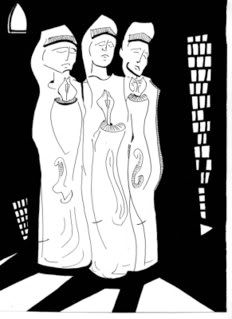
"Vespers"
Image (Copyright © 2008 David McFadden)
Stu Hatton
Linda Benninghoff
Danielle Adair
Mary Kasimor
Bobbi Lurie
Tim Martin
David McFadden
Gertrude Halstead
Bruce Stater
Patrick Mc Manus

Stu Hatton
Down slow (song of samsara)
Beneath the drugs
this is what I am
(very naked)
this is my face:
skin torn up
like carpet,
pair of choking eyes
Have to get sick to slow
down
standing in the quickfire
the lanes of dust
grabbing at particles
my hands
trying to eat clouds
the roads between us
the fish of light
the millions
have to get sick to slow down,
freeze the eyelake over
see the fish of light
frozen swimmers
a library of ice
let's learn to swim down here
while we're dark
our bodies solved
our bodies are much older
than we, than we think
our bodies know everything
have to get sick
to glimpse you
you
not some death girl
forearms awarded
parallel wounds
(you were laying new roads
with the knife)
skin torn up
like carpet,
pair of choking eyes
this is what you are (too)
beneath the drugs
down slow
Stu Hatton is a poet based in Melbourne, Australia whose work has been
published in various journals, e-zines and anthologies. He recently
completed an MA at Deakin University, where he teaches professional
and creative writing. In 2006 he was awarded an Australian Society of
Authors mentorship, which he undertook with Dorothy Porter throughout
2007. He has a book-in-progress entitled How to be hungry.
Stu Hatton Linda Benninghoff Danielle Adair Mary Kasimor Bobbi Lurie Tim Martin David McFadden Gertrude Halstead Bruce Stater Patrick Mc Manus
Beneath the drugs
this is what I am
(very naked)
this is my face:
skin torn up
like carpet,
pair of choking eyes
Have to get sick to slow
down
standing in the quickfire
the lanes of dust
grabbing at particles
my hands
trying to eat clouds
the roads between us
the fish of light
the millions
have to get sick to slow down,
freeze the eyelake over
see the fish of light
frozen swimmers
a library of ice
let's learn to swim down here
while we're dark
our bodies solved
our bodies are much older
than we, than we think
our bodies know everything
have to get sick
to glimpse you
you
not some death girl
forearms awarded
parallel wounds
(you were laying new roads
with the knife)
skin torn up
like carpet,
pair of choking eyes
this is what you are (too)
beneath the drugs
down slow
Stu Hatton is a poet based in Melbourne, Australia whose work has been
published in various journals, e-zines and anthologies. He recently
completed an MA at Deakin University, where he teaches professional
and creative writing. In 2006 he was awarded an Australian Society of
Authors mentorship, which he undertook with Dorothy Porter throughout
2007. He has a book-in-progress entitled How to be hungry.
Stu Hatton Linda Benninghoff Danielle Adair Mary Kasimor Bobbi Lurie Tim Martin David McFadden Gertrude Halstead Bruce Stater Patrick Mc Manus
Linda Benninghoff
For Yvette
After your husband died
you left the burners on
to warm yourself
waking and inhaling smoke.
The burnt-down house sat condemned for a year,
And you cleaned it,
Wearing a hospital mask and gloves.
Taking breaks,
you wandered in your car
down undulating roads
to a field where two horses swished tails,
dropped heads
expectant.
The roan with the white star let you pet her,
but the Appaloosa, who you nicknamed Tommy,
ate raw carrots from your hands.
It brought you peace, you said,
to be feeding horses.
For miles pines, oaks, maples, poplars ran.
The little enclosure where you stood
was capped by the roaring summer sky.
A child again,
you could play,
feel only from a distance
the urgency to mourn.
Linda Benninghoff: I am published in The London Times Online and Agenda, among other journals. I have published two chapbooks and translated The Seafarer from Anglo-Saxon.
Stu Hatton Linda Benninghoff Danielle Adair Mary Kasimor Bobbi Lurie Tim Martin David McFadden Gertrude Halstead Bruce Stater Patrick Mc Manus
After your husband died
you left the burners on
to warm yourself
waking and inhaling smoke.
The burnt-down house sat condemned for a year,
And you cleaned it,
Wearing a hospital mask and gloves.
Taking breaks,
you wandered in your car
down undulating roads
to a field where two horses swished tails,
dropped heads
expectant.
The roan with the white star let you pet her,
but the Appaloosa, who you nicknamed Tommy,
ate raw carrots from your hands.
It brought you peace, you said,
to be feeding horses.
For miles pines, oaks, maples, poplars ran.
The little enclosure where you stood
was capped by the roaring summer sky.
A child again,
you could play,
feel only from a distance
the urgency to mourn.
Linda Benninghoff: I am published in The London Times Online and Agenda, among other journals. I have published two chapbooks and translated The Seafarer from Anglo-Saxon.
Stu Hatton Linda Benninghoff Danielle Adair Mary Kasimor Bobbi Lurie Tim Martin David McFadden Gertrude Halstead Bruce Stater Patrick Mc Manus
Danielle Adair
II
Rose said she didn't "know where [she was] to or where [she had]
been," but that that was okay because she knew that this is where she
was supposed to stay, today, and tomorrow, and the day after, because
her life had "become dull," she said. She said that in Paris,
"Everyone speaks English, Darling." She said she admired Selma for
traveling there alone, and that if Selma had just stood there in one
spot she imagined that "Frenchmen would flock to [her] in dozens."
That Frenchmen would flock to her. Selma tells her that she knows
"everyone there speaks English." That Rose is to be admired for the
glamorous life she has led, and that all the Frenchmen must have
flocked to her; 'how pretty she was.' But when Rose speaks to Selma
she looks into her eyes directly. Despite her faux feelings she looks
straight in. She tells Selma that she is beautiful this day. Selma
contributes in Rose's luxury affair with words, and truly feels their
emptiness there, because she knows them well, but not from that
position. Not from sitting, leg asleep backwards, on her bed. Not from
being taken in so trustfully by someone on her way out who can't name
her the following day, can't discern her own place. But. Now she knows
them from the position of someone watching it all, disconnected from
her past because past brings it feeling. Of someone who can echo
shame but must choose now to rename her secrecy of character. Can't
shadow the discomfort but can't consider it either. What it brings
even its passers don't know.
III
The bird walked like an Egyptian, and Rose said, "My, those trees are
so big." It was funny how the other day Benny told Selma that all the
trees had stopped, not a leaf was moving. And on the following, she
had asked him if he heard that cricket, and he thought she was conning
him, nodding on her imagination by saying, "It's a good thing." Selma
sometimes gets a glimpse at the pillars of trunks on her way
approaching home, and she thinks it isn't all bad to be constantly
falling into bouts of naiveté; drawing all inside the lines is equally
as naive as absurd. Even early, "Running a Redline" had always tried
to be her mantra, but then there are others that attach themselves to
her, like Yesterday's "It's all beneath too much" or June's "No, I
didn't say anything. I thought a few things, but I didn't say much."
It was all as if she'd already told herself it. Too pardoning to be in
field research and too troubled to be in field research. Too insane to
be driven into that small gated community where no one lies, again,
protecting their sphere from the world outside to instead speak plain.
Too antsy to be pulled into that period of nurturing…and she realized,
it's difficult to eavesdrop when you are repeating your own thoughts
and trying to act sincere. Benny told her today that he didn't think
enough before now, and in old age, he thinks too much. It bothers
Selma that she likes him most when he is starving.
V
In this Republic, with him at her flat, Selma learns the meaning of
depression. She's deadened, and she often cries when riding the bus
out to work in the country- the country where her students await her.
"In the nature," some of them say, those who have cottages there to
visit on the weekends. Selma can't not cry, and she is supposed to be
"the strongest one." She pulls out her book even though she hasn't yet
devised her lesson plans. Everyone in Prague brings a book. The Czechs
are indelible students. Selma fake reads to have her head in something
and her eyes on something else. What she thinks is not what she sees,
but she's no prophet. The future's always too predictably predictable
for her. Later after getting off the bus and returning home in this
catatonic winter and with wet boots that crystallize her stride, Selma
wants to, again, cry. Sometimes when she feels this she tells him that
she must go walking. Then she walks around the reservoir and thinks
about that word. "This must be it," but she hears no music. Selma
feels betrayed by the likeness of the words "dreary" and "dreamy"-
"that's not quite right." And she cries, beside herself, on a bench.
It is hard returning home this particular night. Every second person
is a fucking asshole and Selma's mind is not minding her again. Like
not knowing how to say, "bless you" in another language, an awkward
moment is all that she can surrender when passers-by question her
tears through their skittish looks. It's safer there in walking
though, in being just a wanderer rather than one without a title.
"I'll erupt a few stories down I suppose," but length is a
measurement, and, Selma, you're only falling from one place.
Danielle Adair is an interdisciplinary artist based in Los Angeles.
She carries an MFA in Art and in Writing from California Institute of
the Arts and has both performed and exhibited her art extensively
within the US.
Stu Hatton Linda Benninghoff Danielle Adair Mary Kasimor Bobbi Lurie Tim Martin David McFadden Gertrude Halstead Bruce Stater Patrick Mc Manus
Rose said she didn't "know where [she was] to or where [she had]
been," but that that was okay because she knew that this is where she
was supposed to stay, today, and tomorrow, and the day after, because
her life had "become dull," she said. She said that in Paris,
"Everyone speaks English, Darling." She said she admired Selma for
traveling there alone, and that if Selma had just stood there in one
spot she imagined that "Frenchmen would flock to [her] in dozens."
That Frenchmen would flock to her. Selma tells her that she knows
"everyone there speaks English." That Rose is to be admired for the
glamorous life she has led, and that all the Frenchmen must have
flocked to her; 'how pretty she was.' But when Rose speaks to Selma
she looks into her eyes directly. Despite her faux feelings she looks
straight in. She tells Selma that she is beautiful this day. Selma
contributes in Rose's luxury affair with words, and truly feels their
emptiness there, because she knows them well, but not from that
position. Not from sitting, leg asleep backwards, on her bed. Not from
being taken in so trustfully by someone on her way out who can't name
her the following day, can't discern her own place. But. Now she knows
them from the position of someone watching it all, disconnected from
her past because past brings it feeling. Of someone who can echo
shame but must choose now to rename her secrecy of character. Can't
shadow the discomfort but can't consider it either. What it brings
even its passers don't know.
III
The bird walked like an Egyptian, and Rose said, "My, those trees are
so big." It was funny how the other day Benny told Selma that all the
trees had stopped, not a leaf was moving. And on the following, she
had asked him if he heard that cricket, and he thought she was conning
him, nodding on her imagination by saying, "It's a good thing." Selma
sometimes gets a glimpse at the pillars of trunks on her way
approaching home, and she thinks it isn't all bad to be constantly
falling into bouts of naiveté; drawing all inside the lines is equally
as naive as absurd. Even early, "Running a Redline" had always tried
to be her mantra, but then there are others that attach themselves to
her, like Yesterday's "It's all beneath too much" or June's "No, I
didn't say anything. I thought a few things, but I didn't say much."
It was all as if she'd already told herself it. Too pardoning to be in
field research and too troubled to be in field research. Too insane to
be driven into that small gated community where no one lies, again,
protecting their sphere from the world outside to instead speak plain.
Too antsy to be pulled into that period of nurturing…and she realized,
it's difficult to eavesdrop when you are repeating your own thoughts
and trying to act sincere. Benny told her today that he didn't think
enough before now, and in old age, he thinks too much. It bothers
Selma that she likes him most when he is starving.
V
In this Republic, with him at her flat, Selma learns the meaning of
depression. She's deadened, and she often cries when riding the bus
out to work in the country- the country where her students await her.
"In the nature," some of them say, those who have cottages there to
visit on the weekends. Selma can't not cry, and she is supposed to be
"the strongest one." She pulls out her book even though she hasn't yet
devised her lesson plans. Everyone in Prague brings a book. The Czechs
are indelible students. Selma fake reads to have her head in something
and her eyes on something else. What she thinks is not what she sees,
but she's no prophet. The future's always too predictably predictable
for her. Later after getting off the bus and returning home in this
catatonic winter and with wet boots that crystallize her stride, Selma
wants to, again, cry. Sometimes when she feels this she tells him that
she must go walking. Then she walks around the reservoir and thinks
about that word. "This must be it," but she hears no music. Selma
feels betrayed by the likeness of the words "dreary" and "dreamy"-
"that's not quite right." And she cries, beside herself, on a bench.
It is hard returning home this particular night. Every second person
is a fucking asshole and Selma's mind is not minding her again. Like
not knowing how to say, "bless you" in another language, an awkward
moment is all that she can surrender when passers-by question her
tears through their skittish looks. It's safer there in walking
though, in being just a wanderer rather than one without a title.
"I'll erupt a few stories down I suppose," but length is a
measurement, and, Selma, you're only falling from one place.
Danielle Adair is an interdisciplinary artist based in Los Angeles.
She carries an MFA in Art and in Writing from California Institute of
the Arts and has both performed and exhibited her art extensively
within the US.
Stu Hatton Linda Benninghoff Danielle Adair Mary Kasimor Bobbi Lurie Tim Martin David McFadden Gertrude Halstead Bruce Stater Patrick Mc Manus